
Registration
Royal Canadian College of Massage Therapy is Registered as a Career College under the Ontario Career Colleges Act, 2005.
Published November 06, 2026
Earlier this year, at an RMTAO presentation, HST came up again, as it does at these meetings every year. There were a few smiles and a quiet chuckle around the room. RMTs have been hearing about this one for a long time.
This week, it happened.

RMTAO Board Chair Alex Kidd presenting at the RMTAO Town Hall in Toronto, June 2026. RCC students were in attendance.
On November 5, 2026, the federal budget confirmed that qualifying massage therapy services will no longer be subject to GST/HST, for services provided after November 5, 2026. Others may have had some notice, but in our circle, and judging by the reaction online, it came as a real surprise. Just a line in a budget document that many in the field had stopped expecting to see.
For a college training the next generation of RMTs, it's news worth celebrating.
Massage therapists have pushed for this for years. Under federal rules, a health profession can qualify once it's regulated in five or more provinces, and massage therapy reached that mark with Ontario, British Columbia, New Brunswick, Newfoundland and Labrador, and Prince Edward Island. Physiotherapists, chiropractors and other regulated health professionals already had the exemption. RMTs were the odd ones out.
The Registered Massage Therapists' Association of Ontario (RMTAO) and the Canadian Massage Therapist Association (CMTA) led the effort, with letters, meetings with MPs, and petitions signed by thousands of RMTs and patients. Then-Finance Minister Chrystia Freeland confirmed that massage therapy qualified, and a 2024 bill came close, but it never became law. When she left her post suddenly in December 2024, it felt like starting from scratch. The associations kept going anyway. Last year's federal budget left massage therapy out again, and as recently as June, Ottawa would only say the request was under review. Then, with little public warning, it showed up in this week's budget.
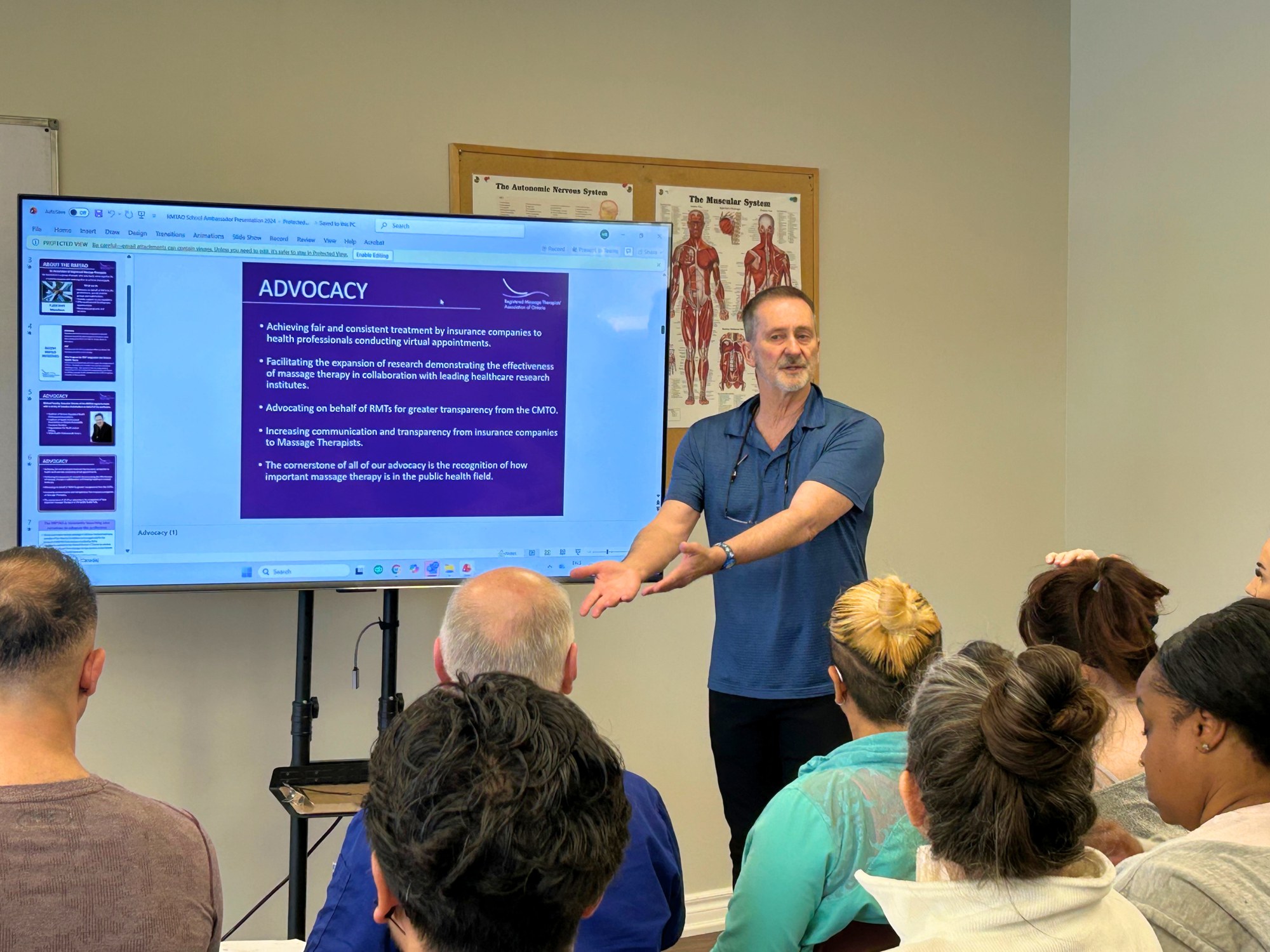
Former RMTAO Board Chair Ian Kamm presenting to RCC students at the RMTAO's annual presentation at RCC, May 2026.
This win is proof of what a professional association can do. Most of the work happens quietly, through letters, meetings and phone calls, and it often takes years. None of it happens without members.
The RMTAO relies on its membership to fund that advocacy and to give it weight. When the association sits down with an MP or the Minister of Finance, the number of RMTs it speaks for matters. In our view, RMTAO membership should be considerably higher than it is, and this news is the best argument we can think of for joining.
That's why RCC hosts the RMTAO at the college at least once a year, and why we encourage every student to sign up for the free student membership and to stay a member after graduation. If you're an RMT who isn't a member, or whose membership has lapsed, now is a good time to join.
This win belongs to many people, the past and present leadership, staff and volunteers at the RMTAO, the CMTA and the provincial massage therapy associations across the country, including many who are no longer in those roles but did much of the heavy lifting. To everyone who kept pushing: congratulations, and thank you. And a special congratulations to Kat Orr, who was named the RMTAO's Executive Director and CEO in September. What a way to start.
For us, the most important part of this change isn't the 13%. It's what the exemption says.
Tax treatment is one of the ways governments signal what they consider health care. By placing massage therapy alongside the other HST-exempt health professions, the federal government is formally recognizing what RMTs, their patients and their colleagues in health care have known for a long time: massage therapy is a regulated health profession, built on clinical education, assessment and accountability to a regulatory college.
That recognition matters to patients choosing their care, to other health professionals making referrals, and to the people deciding whether to enter the field.
This is the question everyone is asking, and the honest answer is that it remains to be seen.
Some therapists and clinics may lower their prices and pass the savings on to patients. Others may keep their rates where they are. Every practice has its own costs and circumstances, and there's no single right answer.
How the change applies will vary from practice to practice, so RMTs should check with their accountant about what it means for them.
We'll be watching with interest to see how the market settles.
Beyond pricing, a few less obvious effects may be worth watching.
Benefits may go further. Many patients pay for massage therapy through extended health plans with annual dollar limits. Where prices come down, those same benefits could cover more visits, which could mean more consistent care rather than the occasional appointment.
Integrated clinics get simpler. Multidisciplinary clinics have often had to treat massage therapy differently from the other services under the same roof. Aligning the tax treatment removes one more line between massage therapy and its neighbouring professions.
Perception shapes careers. We're already seeing a strong shift toward people choosing massage therapy as a second or third career. These are often people who had established careers that were disrupted, and they bring real maturity and life experience to the classroom. For someone weighing a career change, recognition of massage therapy as health care, on equal footing with other professions, makes the decision easier to make with confidence.
What comes next. Once a profession is recognized in one area of policy, it tends to strengthen the case in others, whether that's referral pathways, workplace health programs or public coverage discussions. It will be interesting to see whether this becomes a starting point rather than a finish line.
This exemption arrives as part of a budget that has drawn plenty of debate. Supporters see its spending as necessary to rebuild and strengthen the economy, while critics point to rising deficits and argue the country is spending money it doesn't have. Every tax exemption carries a cost in foregone revenue, and this one is no different.
Wherever people land on the budget as a whole, this measure brings the tax treatment of massage therapy in line with comparable health professions, something the profession has argued for over many years.
After decades of advocacy, a room full of skeptics, and a bill that came close but didn't cross the line, the change finally arrived quietly, tucked into a budget, and to most of us, a complete surprise.
For the students in our classrooms today, it's a reminder that the profession they're entering is still growing and still being recognized. And it's a reminder of what's possible when a profession stays organized, supports its association and keeps making its case.
It gives us hope on another front, too. Many students at private career colleges, and the schools that serve them, are still waiting on OSAP. This week the province signalled it will prioritize resuming OSAP for lower-risk institutions, and it feels like the tide may be turning. We hope that includes massage therapy schools, and that steady pressure pays off there as well.
We're excited to see what comes next.
Royal Canadian College of Massage Therapy
Term 1 and Term 2 emphasis is placed on learning basic knowledge of the Human Body. In Term 3 and Term 4 the focus will be on the application, knowledge, and the refinement of clinical skills.
Royal Canadian College of Massage Therapy is Registered as a Career College under the Ontario Career Colleges Act, 2005.
Please, enter a valid value
Please, enter a valid value