
Registration
Royal Canadian College of Massage Therapy is Registered as a Career College under the Ontario Career Colleges Act, 2005.
Published October 17, 2026
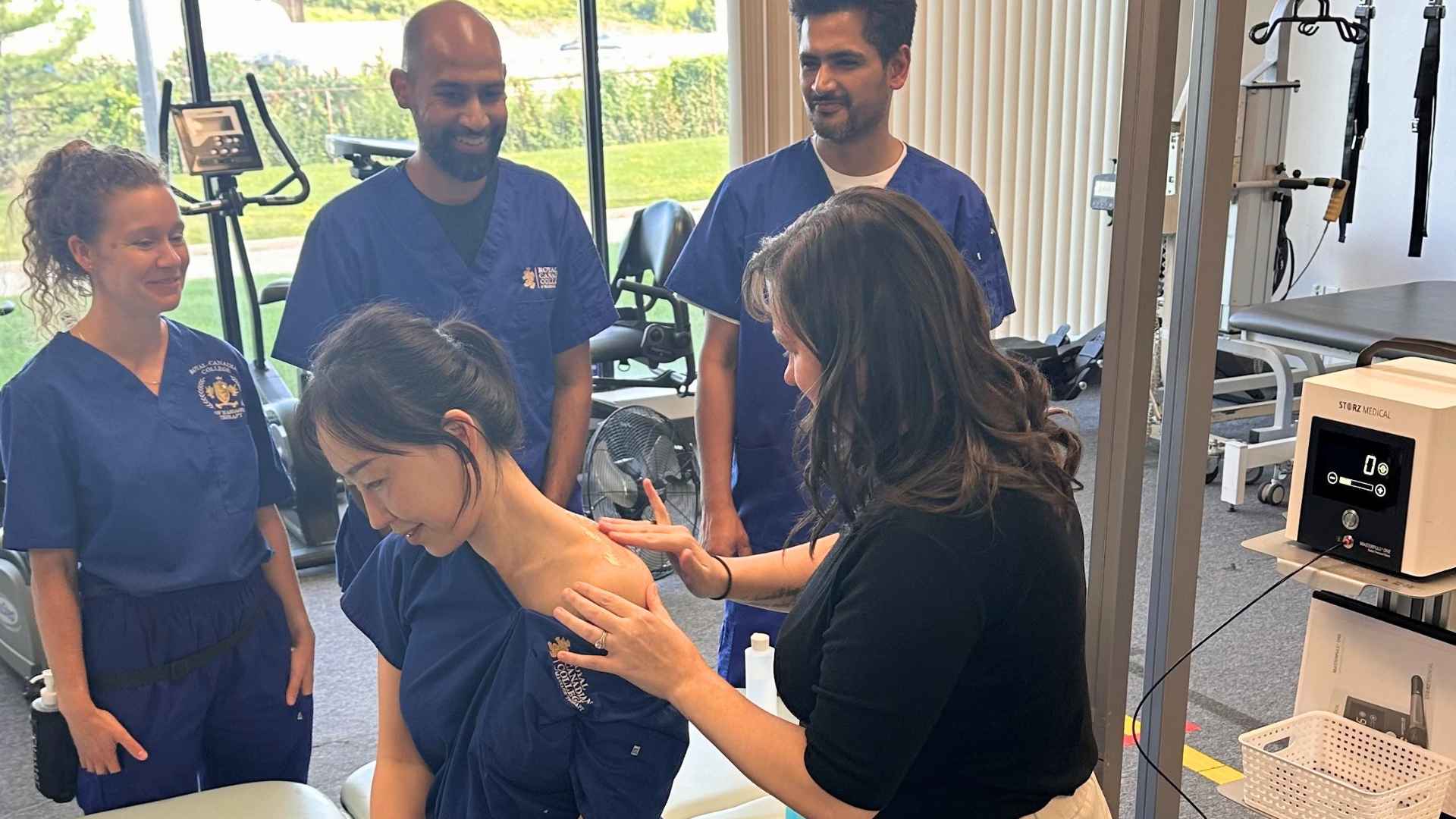
RCC students learn hands-on technique under the guidance of an RMT instructor.
Ontario has paused OSAP payments for students at every private postsecondary institution while an audit and a police investigation look into possible misuse at some schools. Thousands of students who did nothing wrong were approved for OSAP and made plans around it: leaving jobs, signing leases, arranging child care. Now, in the middle of a term, the money they were counting on has stopped or never arrived. The colleges that serve them are left without answers.
The Royal Canadian College of Massage Therapy (RCC) is a small, in-person college in North York that trains registered massage therapists (RMTs). We don't offer OSAP, so the pause changes little for our students. It does give us an unusual vantage point, and we'd like to use it.
If you have been following the news this past week, you can skip ahead to the next section.
Schools that abused the system should face the consequences. But painting every school with the same brush punishes students and colleges that did nothing wrong. Freedom-of-information data reported by The Canadian Press shows that students at just seven career colleges received about as much in provincial OSAP grants in 2024-25 as students at all of Ontario's public colleges combined. Three franchise campuses alone, with about 14,800 students, accounted for more than $219 million that year. Inspection reports filed in court allege third parties completing coursework, sometimes whole courses in a single day, and students who couldn't name their own school or program.
Career Colleges Ontario, the sector's own association, began warning the ministry about suspicious application patterns in January 2023. Honest schools want this cleaned up. Every misused dollar makes it harder for the next legitimate student to get help.
What's hard to accept is that the cost now falls on students who did everything right, and on schools that have followed the rules for years, often decades.

Term 2 students at RCC, partway through their training to become registered massage therapists.
For years, the first question most prospective students ask us is whether we offer OSAP. The answer has been no, and some strong applicants have gone elsewhere because of it. We regularly meet people who love the space, the people and the tour, and then enrol somewhere else because that school offers OSAP, even when its tuition is higher.
Under its previous ownership, the college chose not to apply, largely out of concern about students who might not repay their loans. That wasn't an unreasonable worry; approved colleges share the cost when defaults run high. Under new ownership, the college decided students deserved the option.
That takes time. A college first needs two consecutive years in which at least 55 per cent of students graduate and at least 75 per cent of graduates find work. The employment test exists because OSAP is a loan, and graduates who find work can pay it back. We met those thresholds, applied and completed the required training. Our application was waiting for final sign-off when the pause was announced.
Meanwhile, every student who enrols at RCC has chosen us for reasons other than funding. A few things we've learned from that apply just as much to schools that do offer OSAP.
Students should know what they're signing up for. Our students pay from savings or through an interest-free monthly plan we offer, so we go through the full cost with every applicant before they enrol. OSAP schools are expected to do the same with the debt a student will carry, and some add basic financial literacy training before anyone borrows. One of our instructors, who has taught at schools with and without OSAP, told us that students paying their own way tend to be more accountable, more mature and very serious about finishing and getting to work. That isn't a knock on students who borrow; a loan is paying your own way too, just later. It's a reminder that every student should go in knowing exactly what it will cost.
Price is a discipline. Without OSAP, we've had to set tuition at a level students can actually manage, while competing with schools that offer funding. That keeps a school honest about what its program is worth. When funding flows easily, the pressure eases, and students can end up carrying the difference as debt.
The results are public. In the ministry's latest published figures, 89 per cent of our graduates were employed, well above the average for OSAP-approved career colleges. In 2025, our graduates also passed the provincial licensing exams at a higher rate than the provincial average.
None of this makes OSAP less important. Many good candidates can't study without it. But these habits protect students whether public money is involved or not.
Ontario's rules for colleges seeking OSAP are more demanding than many people realize. Before a school can even apply, it needs years of acceptable graduation and employment results. Once approved, it may not fill out a student's OSAP application or help answer the personal questions on it; each student must apply on their own. The school must also track attendance in every class, and share the cost when too many of its graduates default. We met the entry thresholds and built our financial aid policies around the rest before our application went in.
Staying in is easier than getting in. To qualify the first time, a school needs two years in a row in which at least 75 per cent of graduates looking for work had a job six months later. The ministry's rules for schools that are already approved ask for just one such year out of the last three, with the bar at 65 per cent. And the results arrive slowly: the 2023 figures were released in December 2025. A campus can grow rapidly and draw funding for years before weak results show up.
What seems to have failed is what happens after a school is through that door. The minister has pointed to unusually high numbers of applications coming from the same locations. Reporting suggests the problems clustered in online programs and in a handful of schools whose OSAP volume grew several-fold in two years. Those patterns were visible long before last week.
Ontario isn't the first to face this. Abuse of Australia's vocational student loan scheme drove its cost from about A$325 million in 2012 to A$2.9 billion in 2015, as student numbers jumped almost 400 per cent and fees more than doubled. Australia replaced it with capped loans, a ban on brokers and cold-callers, and tougher entry rules for private colleges based on their track record. Students already enrolled kept their loans through the changeover. Australia went after the abuse, not the students.
Think, too, about who these students are. As we wrote last month, more of the people arriving in our classrooms have already built careers in technology, marketing and media, some of them displaced by AI. They bring focus and maturity, and many excel. They also have families, mortgages and bills, and can't stop working for two years without help. One Ottawa college caught by the pause says more than half its students are over 35. These are the people Ontario should want to retrain, and a funding freeze shuts them out first.
Ontario needs what good private colleges produce: RMTs, personal support workers, early childhood educators, dental hygienists and more. It needs an OSAP system that's hard to abuse and easy to trust, where a few bad actors don't decide the fate of thousands of students.
We would be glad to share what we have learned with the ministry, with other colleges, and with anyone working on a fix.
Royal Canadian College of Massage Therapy
North York, Ontario
Term 1 and Term 2 emphasis is placed on learning basic knowledge of the Human Body. In Term 3 and Term 4 the focus will be on the application, knowledge, and the refinement of clinical skills.
Royal Canadian College of Massage Therapy is Registered as a Career College under the Ontario Career Colleges Act, 2005.
Please, enter a valid value
Please, enter a valid value